

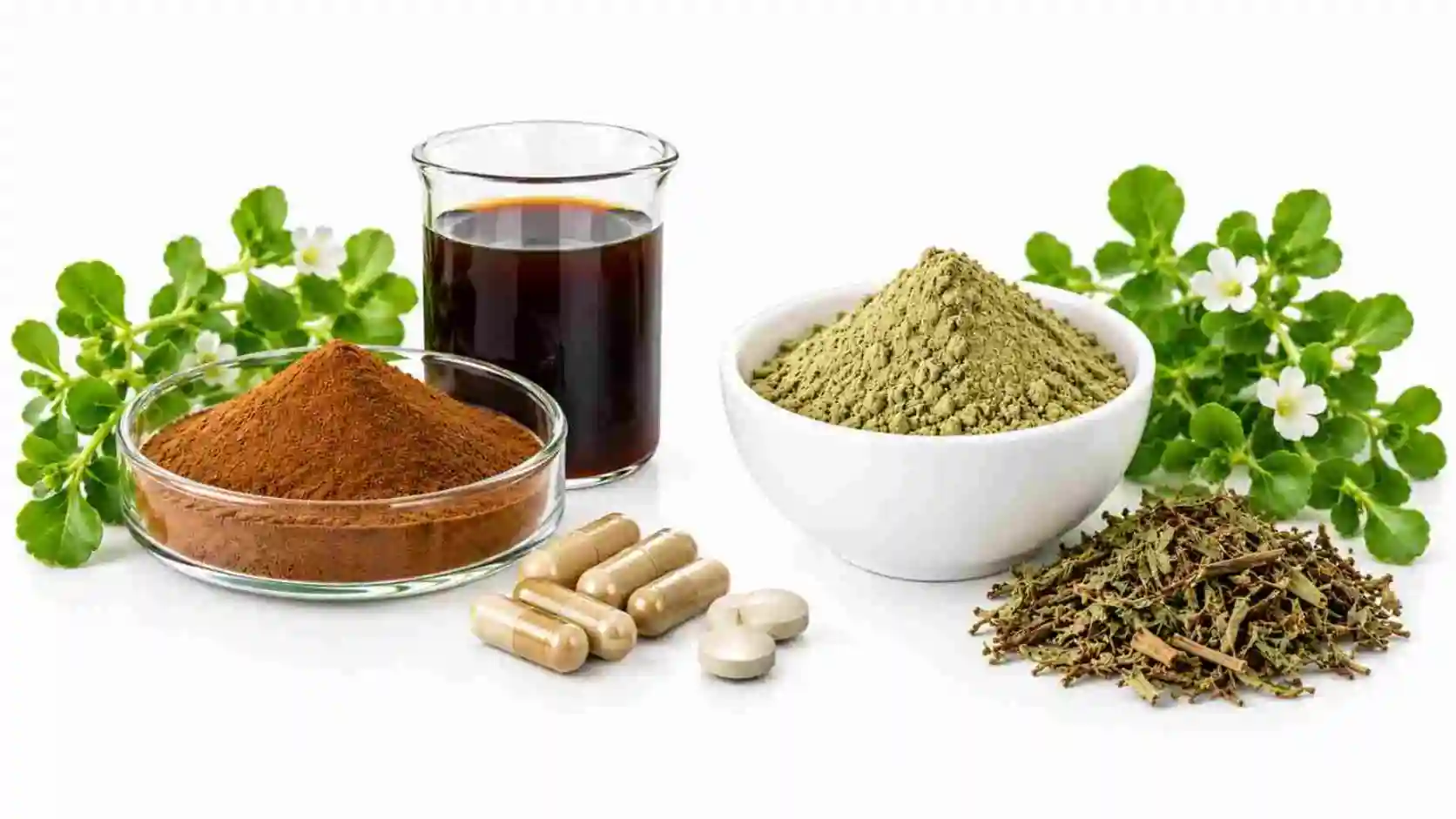
- What Is Brahmi Extract?
- What Is Brahmi Powder?
- Brahmi Extract vs Brahmi Powder: Major Differences
- Brahmi Extract vs Brahmi Powder Comparison Table
- Industrial Applications of Brahmi Extract and Powder
- How to Choose Between Brahmi Extract and Brahmi Powder
- Conclusion: Which Brahmi Ingredient Is Right for You?
Brahmi is an all too familiar herb in ayurvedic and herbal products. A Brahmi extract and a Brahmi powder are derived from the plant material, which is generally more familiar as Bacopa monnieri, but a Brahmi extract is concentrated and can be standardized in potency to marker compounds while a Brahmi powder is not. As such, they can be utilized in different applications by nutritional supplements and herbal and ayurvedic bulk ingredient users and manufacturers to meet their quality and product needs.
What Is Brahmi Extract?
Brahmi extract is made by extracting bacosides obtained from plant material from a Bacopa monnieri. Selected plant components are extracted from the plant material using water or alcohol/water or other appropriate solvents, filtered, and then concentrated. This ingredient can be standardized to a bacosides - the natural constituents used as analytical markers for many traditional Bacopa extracts.
Bacopa monnieri extract is one of the ingredients in nutraceutical capsules, tablets or herbal formulas with standard strength specifications of ingredients. Customers are requested to check the extraction rate, bacoside concentration, solvent and quality packaging information.
What Is Brahmi Powder?
Brahmi powder is a powder that is derived from the plant material dried and then crushed to a finely ground or coarser powder. This is not an extract and will normally have a wider spectrum of plant material present, that is other than the brahmi itself including other plant material such as fibrous material from the root.
Bacopa monnieri powder is a common ingredient in ayurvedic, herbal and whole-herb formulas. Designed in the capsules, as well as additional same powders for blending into other solutions. The amount of powder present may vary, determined by herb sourced, the environment where they grew, and how they are processed. Producers need to make sure the herb comes from a real, fresh, and pure source.
Brahmi Extract vs Brahmi Powder: Major Differences
The main difference between Brahmi extract vs Brahmi powder is how each is made and standardized. Extracts are possibly concentrated in nature with certain levels of bacosides whereas powders consist of ground up herbal plant material with a natural, and broad-spectrum profile.
Processing and Manufacturing Methods
As a general rule, Brahmi extract manufacturers like Durjaya Herbals use an extraction process followed by filtration, concentration and drying to prepare an extract. The kind of extraction process used may vary depending on the specification you have purchased or the solvent required.
Brahmi powder is the powder form that is normally made from washing, sun-drying and powdering the whole herb and it is relatively simple with some plant matrix left in the finished powder. Both types of processing involve hygienic measures, processing controls and quality verification to ensure the product safety.
Bacoside Content and Concentration
Bacoside levels are an important factor when deciding between these ingredients. Bacoside content can be measured and Brahmi extract can be standardized to a set bacoside level, if a scientifically quantified baccoside level is needed.
Brahmi powder but not always to the same extent or with the same standardization. Bacosides are present in varying amounts in different batches. Consumers should ask to see lab reports and not take any assumptions about the amount of bacosides based solely on the Brahmi powder label name.
Physical Properties and Formulation Suitability
Brahmi extract is commonly supplied as a powder, though colour, texture, bulk density and solubility will all vary according to the manufacturing method and any dilutions or carriers included. It may be better suited to formulations that benefit from a more potent ingredient.
Brahmi powder is generally a plant-based powder which will have the usual colour, scent and texture. The flow and handling characteristics of this product will be impacted by the particle size and moisture content and it is suitable for use with traditional products and whole-herb blends as well as where a powder would be appropriate.
Brahmi Extract vs Brahmi Powder Comparison Table
The table below sets out the key contrasts for commercial buyers.
| Parameter | Brahmi Extract | Brahmi Powder |
|---|---|---|
| Processing | Extraction, filtration, concentration and drying | Drying and milling |
| Composition | Selected, concentrated plant constituents | Broader plant material |
| Bacoside content | May be standardized to a specified level | Usually varies naturally |
| Physical form | Often a fine powder; properties vary | Milled herb powder |
| Quality specifications | May include bacoside percentage and extraction details | May include botanical identity, moisture and purity |
| Applications | Standardized nutraceuticals and herbal formulations | Traditional herbal blends and whole-herb products |
| Cost considerations | Depends on concentration, standardization and processing | Depends on raw material, processing and quality |
The right choice will vary on how much ingredient strength is needed, the product form and the production budget. Consumers should evaluate products by these real specs and not just the cost.
Industrial Applications of Brahmi Extract and Powder
Both ingredients are used in herbal and nutraceutical manufacturing. It is a matter of the finished product being a standardized Brahmi extract or a whole-herb.
Nutraceutical Capsules and Tablets
Brahmi extract is mainly proposed as being fit for inclusion in control nutraceutical capsules and tablets. E.g. Bacopa capsules – in which a particular level of bacosides has been established. Usability will be related to dose, excipients, stability and process.
Brahmi powder may also be encapsulated or tabletted (when formulated as whole-herb material). However, due to the powder's bulk, flow and variable make-up, limitations need to be taken into account.
Ayurvedic and Herbal Formulations
Brahmi powder can be used in traditional herbal blends or powder blends as well as preparations that are specified to contain the whole herb. The natural matrix of the plants may be essential to the product.
Brahmi extract has a defined marker in tablets, capsules and other herbal preparations used where the medicinal requirements of Brahmi extract are to be met by a more concentrated form. The form must also comply with the relevant specification for a particular product and its intended use.
How to Choose Between Brahmi Extract and Brahmi Powder
Deciding between Brahmi extract and Brahmi powder can be based on product needs, supplier dependability, and quality standards.
- Active-marker specifications: Opt for an extract if specified quantity of bacosides matters, otherwise request analytics for powders.
- Preparation: Choose extracts for concentrated formulas and powders of the entire herb for more classical formulas if the powder of the whole herb is needed.
- Quality testing: Botanical identification, microbial limits, heavy metals, pesticide residues.
- Batch quality: Review the certificate of analysis (COA), product specification and batch-to-batch testing process.
- Manufacturing advantages: Decide on particle size, bulk density, moisture and flow properties. Stability of the future formulation with Brahmi extract manufacturers.
- Cost and data: Know the cost per used-able quantity of material (€/kg is not accurate). Seek traceability, technical data sheets and compliance data of the market you will work in.
Samples can be requested from Brahmi extract suppliers like Durjaya Herbals and the user has to check whether the material complies with the technical requirements. Companies interested in Brahmi extract from the international market may also approach the Brahmi extract exporters for export documentation, packagings, traceability, uniformity in shipments etc.
Conclusion: Which Brahmi Ingredient Is Right for You?
Brahmi extract is a concentrated product with specific specification for each individual bacosides Brahmi powder; if they require a standardised form of the whole herb, i.e. a fresh-herb form of the entire plant. There is no right or wrong in these choices, and the optimal choice for your product depends on your formulation, analytical, quality and cost requirements.
If the ingredient has a uniform batch you can order, see the product here – Brahmi extract exporters, view detailed specifications and Bacoside content and quality documents for bulk orders. Consistent production is supported by choosing an established supplier like Durjaya Herbals.
Brahmi extract is a concentration of selected plant compounds. Brahmi powder is powdered and dried plant material.
Usually yes, when Brahmi is Bacopa monnieri. Cross-check the botanical name on the back of the packaging as there may be different common names in different markets.
Brahmi extract is more standardised. Actual bacoside level is best to be confirmed with laboratory analysis.
Yes. Brahmi Powder may be taken in capsule form if it passes quality, formulation, and intended product specifications requirements.
Routine quality checks involve verification of botanical identity, bacoside content, microbial contaminants, heavy metals, along with other tests as applicable.
Check the COA, bacoside specification, look at the sample, batch consistency, and traceability and compare with the requested supplier documentation.
Durjaya Herbals can be evaluated as a sourcing option for Brahmi extract based on product specifications, bacoside content, quality testing, batch consistency, and documentation. Buyers should confirm the company's available grades, testing standards, and bulk supply capabilities before placing an order.